





A landmark study has exposed systemic disadvantage and racism experienced by Australian South Sea Islanders in Queensland, with researchers calling for the creation of dedicated community "navigators" to help families access essential services.
Led by James Cook University (JCU) in partnership with the Queensland United Australian South Sea Islander Council (QUASSIC), it found while South Sea Islanders are often more likely to be employed than Queenslanders overall, home ownership rates and equitable access to services remain persistent challenges.
"Australian South Sea Islanders helped build Queensland's agricultural economy, yet they have only been officially recognised as a distinct people group for 25 years — and the systems that should support South Sea Islanders still aren't designed with them in mind," lead researcher Michelle Redman-MacLaren said.
"The systems we have — especially in education, health and housing — are not set up for Australian South Sea Islander communities or a collective way of life, and yet community members are trying to navigate systems built for individuals and nuclear families."
The research combined the analysis of Australian Bureau of Statistics Census data with in-depth interviews documenting the lived experiences of Australian South Sea Islanders across the state.
"While there have been some improvements in areas such as education and employment, in other areas such as housing and access to government services, little to no progress has been made," it said.
"Racism remains a clear challenge for many Australian South Sea Islanders in Queensland. Institutional and structural impediments mean people experience being 'caught in a web' and find it hard to move forward."
South Sea Islander woman and newly enrolled JCU PhD candidate, Zia Youse, was a key member of the research team and plans to undertake further research building on the findings.
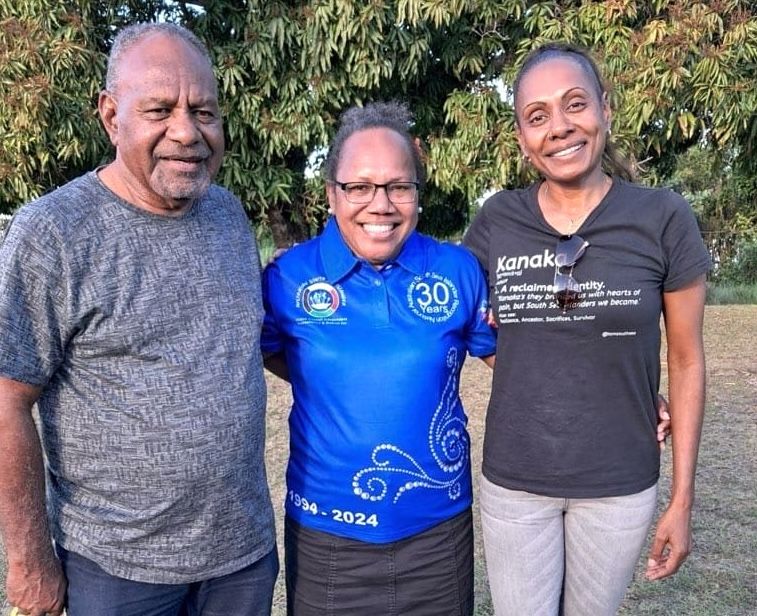
"The report shows the community is calling for stronger recognition of Australian South Sea Islander identity," she said.
"Promoting the visibility of the Australian South Sea Islander flag builds pride and belonging and expanding initiatives like the Kanaka Proud Cup will strengthen opportunities for young people to express their identity through football."
The research, from first-hand accounts of 41 South Sea Islanders — across multiple generations — used the story-based Pacific method of tok stori to document people's lives, helping lay a foundation for future improvements in identity recognition, housing access, higher education participation, and health and aged care outcomes.
"We are proud to be South Sea Islander, but others don't know who we are," one respondent said.
"We learn in many different ways [and] embrace opportunities — we work hard. To get health services we use relational access to the system. We live with racism, and we just try to get on with life. Disadvantage exists. It looks different since Federal and State recognition. It also looks different depending on where you live across Queensland."
The report recommended the creation of funded Australian South Sea Islander "navigators" — trusted community-based workers who can help families navigate education, health, housing and other government systems.
"We already see elders informally guiding people through hospitals and services," Assoc Prof Redman-MacLaren said. "Formalising and funding these roles is a practical, evidence-based way to improve outcomes for Australian South Sea Islanders."
Despite strong employment — particularly in education, health, mining and trades — the research also found South Sea Islanders have lower rates of home ownership and are under-represented in university-level qualifications, even as participation in trades and technical education grows.
Furthermore, it also identified serious undercounting in census data, contributing to under-recognition and a lack of targeted government support.
In the introduction to the report, QUASSIC president Clacy Fatnowna noted: "One of the challenges faced by our community is the lack of relevant data that can be utilised as evidence to support our needs. Furthermore, there is a need for ongoing conversations around what works and what does not work."
In the 2016 census, 6,826 Queenslanders identified as Australian South Sea Islanders, but by 2021 that figure had dropped to 5,562 despite the community clearly not shrinking — a problem researchers say is linked to how identity is recorded on census forms.
"With the Australian Census taking place on 11 August this year, QUASSIC will be leading a public education campaign to ensure our community understands how to correctly identify as Australian South Sea Islander," Mr Fatnowna said.
"Accurate identification is critical, as government resources and future service planning are directly linked to these Census numbers."