




Japan has handed over a new dredger to Fiji to strengthen flood mitigation capacity and improve long-term climate resilience, as authorities move to better protect farmland, infrastructure and vulnerable communities.
The dredger has been transferred to the Ministry of Agriculture, Waterways and Sugar Industry and will be deployed to clear silted waterways, improve drainage and reduce flood risks in river mouths and low-lying areas.
The handover forms part of ongoing cooperation between Fiji and Japan to address the increasing impacts of climate change, including heavier rainfall, river siltation and recurring floods that threaten food production and rural livelihoods.
Fiji's Minister for Agriculture, Waterways and Sugar Industry, Tomasi Tunabuna, said the new equipment would play a critical role in protecting farmers and food security.
"These floods do not just damage infrastructure; they threaten the livelihoods of our farmers and the food security of our nation," he said.
"This is not an isolated event, but part of a remarkable journey of cooperation between our two nations."
The dredger will support the Ministry's flood mitigation strategy by enabling the clearing of debris-filled waterways, increasing river discharge capacity and reducing inland flooding that affects agricultural land and residential communities.
"These machines are already on the ground, working in our rural and maritime communities," Mr Tunabuna said.
"The addition of this dredging machine completes a vital cycle of logistical support that allows my Ministry to respond more effectively to the needs of our people."
The dredger was officially handed over at the Ministry's Luvuluvu Station in Nausori and was funded through Japan's Grant Aid for Economic and Social Development.
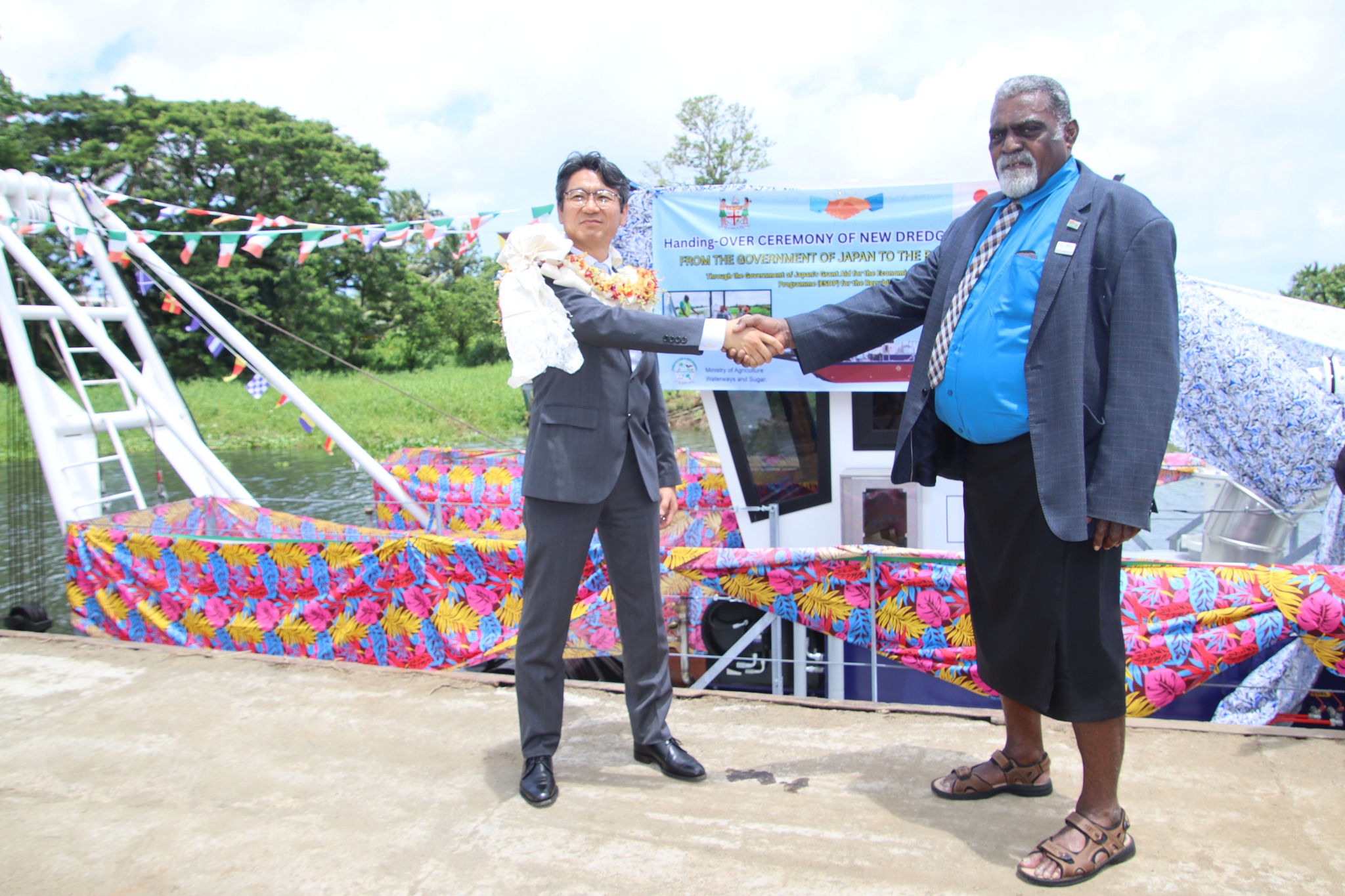
The equipment forms part of a wider disaster risk reduction commitment by the Government of Japan, which also includes tsunami early warning systems and an ice-making plant already delivered to Lautoka.
Counsellor and Deputy Head of Mission of the Embassy of Japan to Fiji, Isami Takada, said the dredger reflects a shift from disaster response to long-term resilience.
"This project, provided through Japan's Grant Aid for Economic and Social Development, is more than the transfer of machinery," he said.
"It reflects the trust built between Japan and Fiji through our shared experience of disaster risk and our common commitment to protecting lives and livelihoods."
Japan pledged disaster risk reduction equipment valued at JPY $848 million, comprising the dredger, tsunami early warning systems and the ice-making plant.
"The dredger is now handed over to your Ministry, the ice-making plant has already been handed over in Lautoka, and the tsunami early warning systems will soon be provided to the National Disaster Management Office," he said.
"These are investments that enhance security today and resilience for tomorrow."
The dredger will reduce flood risks by improving drainage and river mouths, protecting farmland from siltation and waterlogging, and supporting safer coastal and river navigation before, during and after extreme weather events.
Fiji remains highly vulnerable to climate change, with increasingly intense weather events placing pressure on infrastructure, farming systems and community livelihoods.
Mr Tunabuna acknowledged Japan's continued support and described the assistance as a reflection of the strong relationship between the two countries.
"The 'Kizuna' - the emotional bond between Japan and Fiji - is reflected in the quality and sincerity of this assistance," he said.
"These machines are not just steel and engines; they represent Japan's commitment to standing with Fiji in our time of need."
The Ministry of Agriculture, Waterways and Sugar Industry said the dredger will be integrated into national flood mitigation programs, with a focus on protecting food production, livelihoods and critical infrastructure as Fiji adapts to climate change.