





Wild pigs have long been a major issue for Samoan farmers, damaging crops and pastures and discouraging agricultural investment.
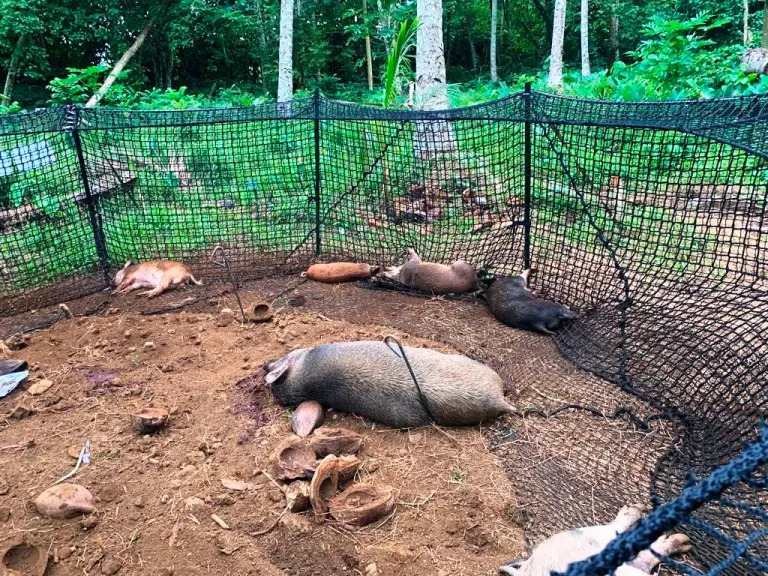
Earlier this week, the Scientific Research Organisation of Samoa (SROS), alongside the Ministry of Agriculture and Fisheries (MAF) and the Australian and New Zealand-funded Market Development Facility (MDF), launched trials aimed at controlling and potentially eradicating the wild pigs threatening Samoa's food security.
The problem not only disrupts agriculture but also deters investment, contributing to elevated food prices.
SROS chief executive Pousui Dr Fiame Leo expressed his optimism about the new initiative.
"This collaboration represents a significant milestone in our efforts to mitigate the impact of feral pigs on Samoan agriculture," he said.
"By trialling innovative management measures, we aim to alleviate the burden faced by farmers and promote sustainable agricultural practices."
The Australian High Commissioner His Excellency William Robinson previously said he has a lot to learn about Samoa but is happy to support locally led developments.
"I cannot promise you anything but happy to support," he said.
The study tour began in Brisbane on Tuesday, where the Samoan delegation met with the Australian National Feral Pig Management Coordinator to discuss Australia's approach, including the National Feral Pig Action Plan.
Heading to Cooktown, the delegation plans to meet with Australian experts and Indigenous communities, including the Junjuwarra Traditional Owners at Starcke.
The meetings will showcase how traditional landowners have effectively applied feral pig management and monitoring practices.
The study tour ends with a visit to the Canegrowers Association in Innisfail, where the group will observe demonstrations on feral pig management and monitoring techniques.
The association will highlight innovative practices that have helped reduce the impact of feral pigs on sugarcane farming.
This tour marks a significant step for Samoa in tackling its feral pig challenges and offers a valuable opportunity for the exchange of knowledge between Samoa and Australia.