





Nothing is more symbolic of Rapa Nui – the Polynesian name for both the Indigenous people of the eastern Pacific and their Easter Island homeland – than their mo'ai statues.
The monolithic human figures carved out of the island quarry stone up to 800 years ago remain a mystery to the world.
But the unveiling of a permanent mo'ai exhibition at the Australian Museum on Saturday began to shed new light on the sacred creations of the Rapa Nui people.
There is still some conjecture over the arrival of the Rapa Nui people from Polynesia, but a 2007 study provided compelling evidence to suggest their arrival on the island occurred around 1200 AD.
For hundreds of years, the Rapa Nui had no contact with the outside world including other distantly-related Polynesians.
During this time – up until the early 1700s when Chile laid claim to the territory around 3500km from the South American coast – Rapa Nui culture flourished with about 900 mo'ai ahu, that is the stone platforms, carved from volcanic rock of the quarry from its famous Rano Raraku crater.
Several hundred of the mo'ai still stand lining the crater, but there are close to 100 mo'ai that either fell or were deliberately toppled including many that allegedly were moved.
Here is where the great mysteries of the Rapa Nui unfold. Every mo'ai weighs more than 12 tonnes each. The lack of forested trees, according to Rapa Nui oral tradition, exp'lains how the mo'ai have spread.
Culturally, the statues stand guard, nearly all gazing inland across their clan lands. There were apparently once large palm trees that were cut down to transport the huge stone busts to their ahu. Other trees were made into canoes that proved inappropriate for fishing.
There was not enough food to sustain the Rapa Nui people on the island, and the legend goes that triggered internal tribal conflict and prompted the masses to topple the some of the mo'ai.
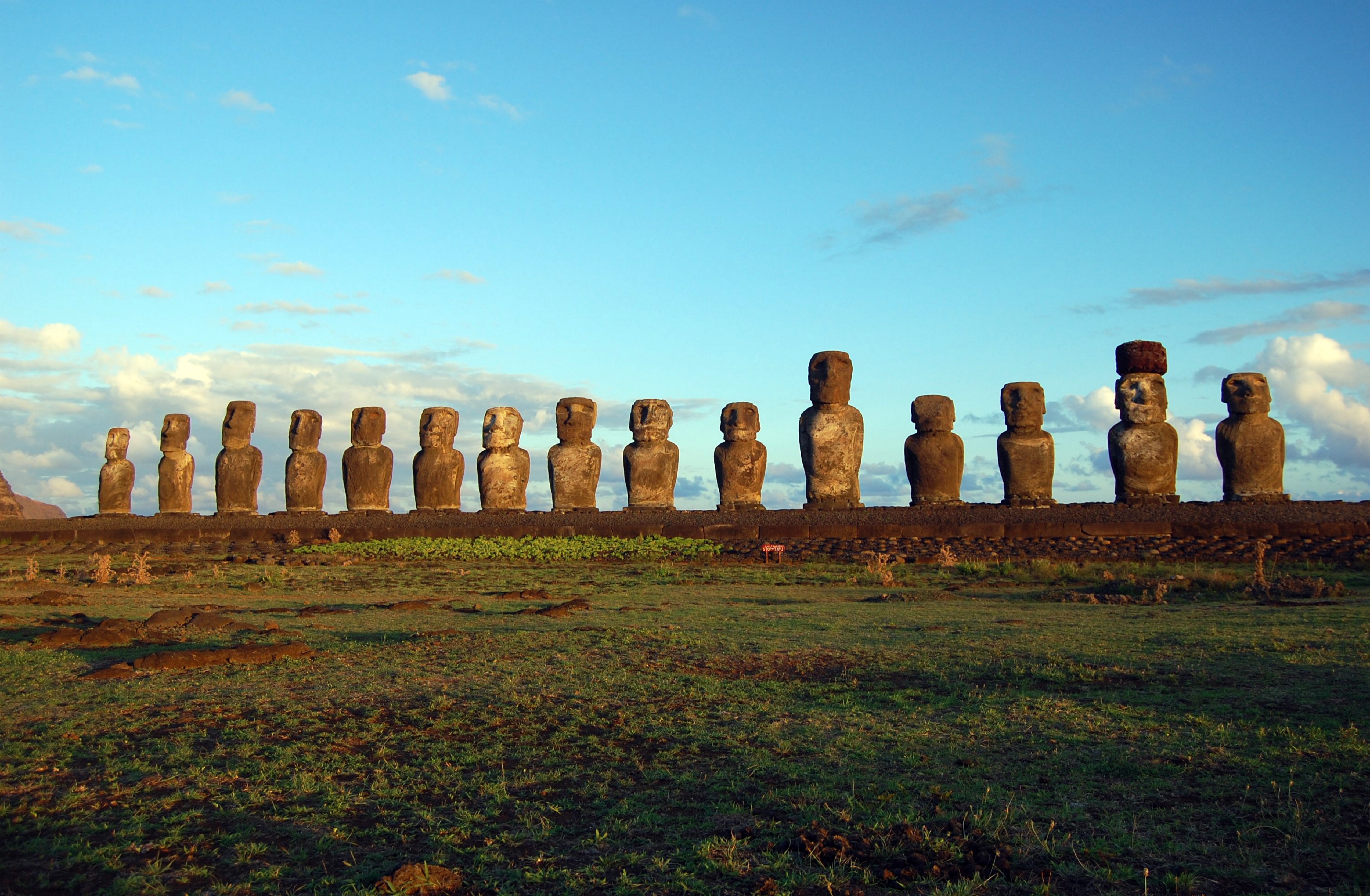
Rapa Nui guide Beno Atan tells visitors the sacred mo'ai represented the Polynesians that created a society on the island and so they faced to their Hera homeland.
Modern Rapa Nui proudly demonstrate how the mo'ai are moved to their ahu using the logs with some rope.
The ingenious technique is simple enough and requires relatively little manpower as the mo'ai are moulded from their bases for easy rocking on specially-constructed dirt tracks.
But Atan adds that oral tradition suggests they, in fact, "walked" via spiritual forces, some Rapa Nui say supernatural power, called mana. That comes from a meditation circle on the southern shores of the island, where in the centre lies a large, yet a smooth boulder.
Those Rapa Nui descendants with mana, oral tradition says, would sit at this circle, their hands drawing power from the boulder.
Another cultural legend is this boulder received its great power as the place where the umbilical cord of the first-born Rapa Nui was cut.
Atan comes from a line of Rapa Nui dating back several generations.
His grandfather "discovered" a female mo'ai made of basalt where his Atan's father was christened.
"Everybody on the island who is Rapa Nui knows their genealogy," Atan said.
"If they don't know, they at least know which tribe they belong to."
The mo'ai exhibition in Sydney ties into the Wansolmoana – meaning one salt ocean – portion of the museum to reflect the cultural significance of the immense body of water that connects the islands and people across the Pacific region.
Museum curators say the Wansolmoana blends the wisdom of Pasifika ancestors with "the voices of the present".
The Pasifika staff – cultural-knowledge holders – in Sydney celebrate the "complex, varied and dynamic cultures and languages" of its own peoples.