



A unique program at the University of Toronto is helping Indigenous students explore careers in health care by integrating traditional knowledge with medical education.
The ZKA'AN NI-BMIWDOOWIN GCHI-KINOOMAADWINAN (ZNBGK) program, also known as Building the Fire, Walking with Medicine, runs for one week each summer and offers students hands-on learning experiences in medical sciences.
Among the participants this year was Grade 10 student Charli Mackay, who says the program broadened her perspective on career possibilities in health care.
"ZNBGK really opened my eyes to pursuing a career in the medical sciences," she said.
"It was exciting to see just how broad the field is.
"There are so many more options available than I had realised, I'm really drawn to research and imaging."
Launched as a pilot in 2021, ZNBGK aims to increase Indigenous participation in health-care professions by providing students in Grades 9 and 10 with culturally appropriate programming.
This includes land-based learning, mentorship opportunities, and exposure to Indigenous leadership, governance systems, and healing practices.
Temerty Medicine's office of Indigenous health and office of access and outreach collaborated with Ganawishkadawe – the Centre for Wise Practices in Indigenous Health at Women's College Hospital – to offer a diverse range of clinical experiences.
Ryan Giroux, a paediatricians at St. Michael's Hospital and Indigenous health lead for postgraduate medical education at Temerty Medicine, highlighted the importance of collaboration.
"The proportion of Indigenous faculty members is small, so it's critical to think and collaborate across institutions," he said.
"If this program only operated within a single organisation, that would risk not being able to provide the community what they need."
This year's program included a lab tour at the MaRS Discovery District, discussions with Women's College Hospital CEO Heather McPherson and Temerty Medicine faculty members, and an image-based journaling workshop with postdoctoral researcher Lisa Boivin.
Students also participated in holistic healing sessions and simulation activities at Unity Health Toronto's La Ki Shing Knowledge Institute.
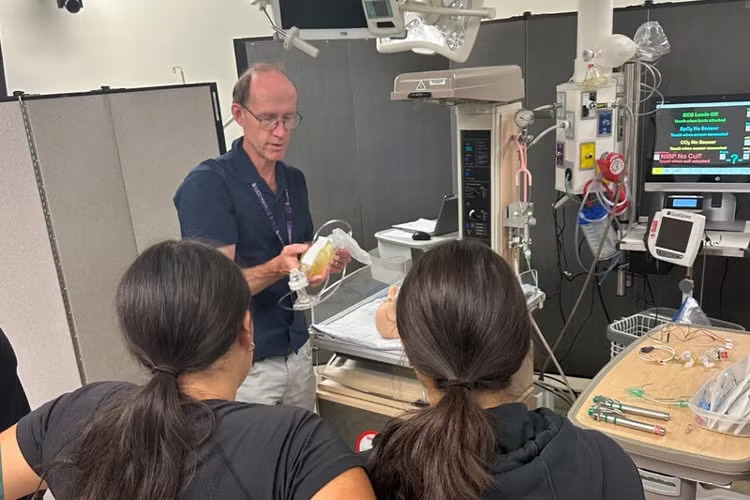
Doug Campbell, an associate professor of paediatrics at Temerty Medicine, co-led the simulation session and emphasised its broader impact.
"Simulation in health care is often thought of as a way to teach someone how to do a task, but it offers far more than that," he said.
"We've always kept in mind that we can advocate and share educational experiences with the community."
During the session, students learned about the work of paediatricians and neonatologists before practicing procedures such as inserting an umbilical vein catheter and ventilating a newborn mannequin.
"I believe we have an obligation to open doors to historically marginalised communities," Associate Professor Campbell said.
"As we open our eyes to what's happened in the past, we also need to think about how we interact day-to-day with people in the future.
"Our duty to care needs to continually evolve. We have an obligation to move forward on the path of reconciliation."
The program also included visits to First Nations House, the Earth Sciences courtyard, and activities such as drumming, songs, and smudging.
Elder-in-Residence Kawennanoron Cindy White provided traditional teachings and spiritual guidance throughout the week.
Ms Mackay found White's journey particularly inspiring.
"She really emphasised that better is always possible," Ms Mackay said.