




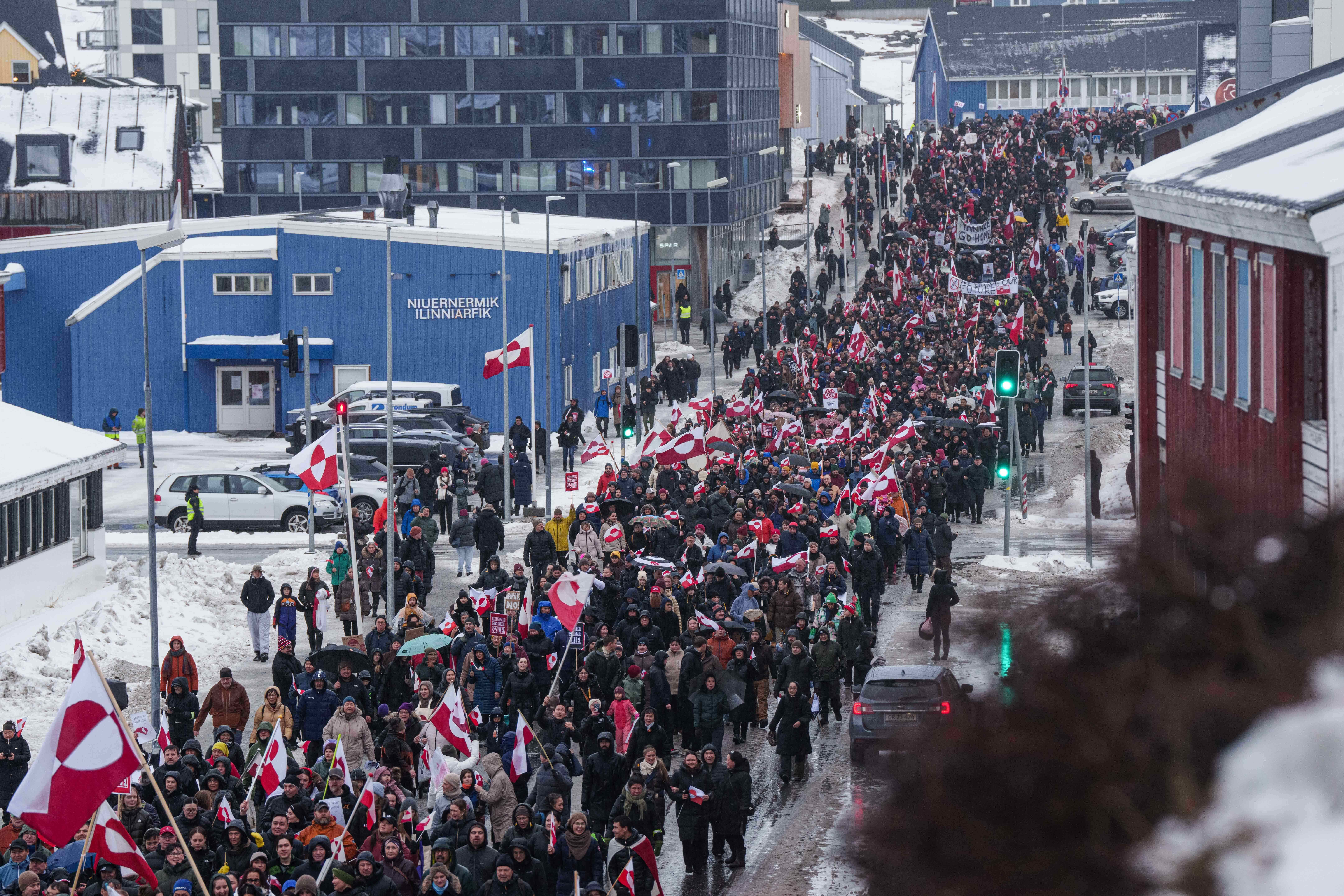
Several thousand largely Inuit protesters marched on Sunday against threats from US President Donald Trump to annex Greenland / Kalaallit Nunaat against its will.
They carried protest signs, waved their national flag, chanting "Greenland is not for sale" in their capital Nuuk on their way to the US consulate.
The protest on Saturday was attended by one quarter of the city's entire population.
Indigenous Inuit make up more than 90 per cent of Greenland's 57,000 residents.
Kalaalit Nunaat, the Indigenous name for Greenland, is one of five sovereign lands for the Inuit people recognised by the United Nations.
Mr Trump has long argued the US should own the mineral-rich island, which remains a self-governing territory within the Danish Commonwealth and has long-held ties with Europe but geographically is aligned to the continent of North America.
However, Inuit advocacy groups say they are tired of being used as geopolitical pawns by world leaders.
"We want to say loud and clear that there's no such thing as a better coloniser," Sara Olsvig, the chair of the Inuit Circumpolar Council and a former member of both the Greenlandic parliament, told the Canadian Broadcasting Corporation.
"We have already been through colonisation, and we know what it means when the interests of others and more powerful nations and peoples affects us negatively and when decisions are taken thousands of kilometres away from us."
According to a recent poll from an independent researcher, President Trump's desire to control Greenland disregards the fact the Inuit people overwhelmingly do not want to be part of the US, while a significant number also want full independence from Denmark.
Inuit people also feared Greenland may become the Arctic equivalent of American Samoa or Puerto Rico - US overseas territories where residents lack constitutional protections and have no voting representatives in the US House of Representatives or Senate.
Ms Olsvig said while Inuit want greater self-determination, they also want to be a part of stronger international forums such as the Arctic Council that already includes the Indigenous Inuktitut people of Eastern Canada and also and Northern Sámi people of Scandinavia.
"We have been able to work together based on mutual respect," she said.
"We have been able to maintain a zone of peace in the Arctic even through difficult times before and I think it lies upon every leader, who has something to say in the Arctic, to stand strong on those values, on calling for diplomacy to work."
The system of military and political alliances that has underpinned a world global order since the end of the Second World War hangs in the balance for Greenland.
A meeting is scheduled between both Danish and Greenlandic foreign ministers with US state secretary Marco Rubio and Vice President JD Vance in Washington on Wednesday.
Inuit man Karl Sandgreen, head of the Ilulissat Icefjord visitor centre in the Western Greenland fjord, fears for the Inuit way of life after Greenlanders have witnessed the harsh ways that Inuit people are treated in the US state of Alaska.
"My hope is that Rubio is going to have some humanity in that talk," he told Al Jazeera.
"We are totally different (to Americans). We are Inuit, and we've been living here for thousands of years.
"This is my daughter's and my son's future, not a future for people who are thinking about resources."
Greenland's mineral sector has been a point of geopolitical interest for President Trump over a number of years dating back to his first term.
The autonomous territory has 25 of the 34 critical raw materials that has been identified by the European Union, including rare earth elements (REE), graphite, zinc and uranium.
The melting of ice sheets from ongoing global warming makes the resources more accessible despite environmental policies backed by Inuit stakeholders and its ruling Ataqatigit party.
A solidarity rally was also held in Iqaluit, the capital of the Inuit-governed territory of Nunavut in Canada's far north that split from the Northwest Territories province in 1999 as an Indigenous homeland.
Aaju Peter, an experienced Inuit lawyer born in Greenland but a longtime Nunavut resident, said Greenland appears to be at the mercy of the US even though the Trump administration looks to flout both international law and the Inuit right to self-determination.
"Greenlandic leaders and the (Inuit) population are willing to talk with the president, or with the administration in the White House, diplomatically, with respect ... that the Greenlandic Inuit are sovereign and they can make their own decisions," she told the Associated Press.