





The Treaty Principles Bill, which aimed to redefine the legal status of Aotearoa's founding document, has been decisively voted down in Parliament.
Only 11 members of the ACT Party supported the bill, with all other parties - including the governing National and New Zealand First - voting against it.
As the result was confirmed, the chamber erupted in celebration.
Members of Parliament and supporters in the gallery sang a waiata, Tūtira mai ngā iwi, as Speaker Gerry Brownlee tried to maintain order.
Te Pāti Māori MP Hana-Rawhiti Maipi-Clarke, who has been a strong voice against the bill throughout its progress, welcomed the outcome.
She told the House the overwhelming response to the bill had proven the country was not as divided as some had suggested.
"This bill has been absolutely annihilated," she said.
"We had two choices: to live or to die. We chose to live."
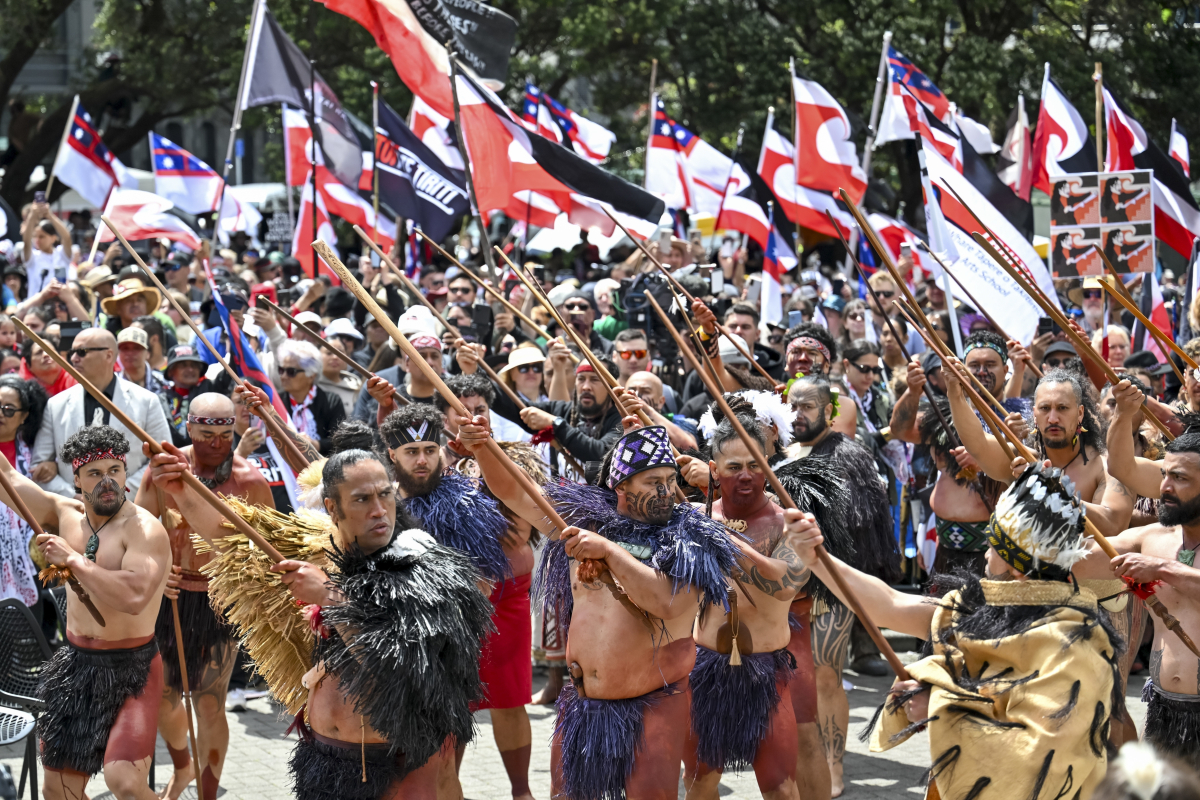
The hīkoi united ten-of-thousands across Aotearoa in a powerful display of Māori resistance and solidarity. (Image: AP Photo)
The bill, introduced by ACT leader David Seymour as part of a 2023 coalition agreement, sought to replace decades of legal interpretation of the Treaty of Waitangi with a fixed, narrower definition.
It would have removed established Treaty principles such as partnership and Māori self-determination and proposed putting those changes to a national referendum.
Despite gaining initial backing to progress the bill, Prime Minister Christopher Luxon did not attend Thursday's debate or vote.
His National Party ultimately voted against it, with Māori Development Minister Tama Potaka previously saying he looked forward to its "cremation."
Opposition to the bill was strong and sustained.
In November, an estimated 40,000 people marched on Parliament during the Hīkoi mō te Tiriti.
Earlier, more than 300,000 public submissions were received by the select committee, the majority opposing the bill.
Labour leader Chris Hipkins described the legislation as "a grubby little bill, born of a grubby little deal."
"It will forever be a stain on our country," he said.
Despite the bill's defeat, Mr Seymour remained defiant.
"A free society takes hard work and uneasy conversations. I'm proud my party has the bravery to raise uneasy topics," he said.
He told the chamber he would "fight on".
The Treaty of Waitangi, signed in 1840 between more than 500 Māori chiefs and the British Crown, is widely regarded as the foundation of modern Aotearoa / New Zealand.
Over recent decades, courts and the Waitangi Tribunal have established principles that help guide its interpretation in law.
The defeat of the Treaty Principles Bill holds wider significance beyond Aotearoa.
In Australia, similar tensions have played out, where state and federal governments have often been slow or resistant to fully recognising Indigenous sovereignty and self-determination.
In Queensland, the axing of the Truth-telling and Healing Inquiry has raised concerns among Aboriginal leaders about whether governments are truly committed to structural change.
Both cases show how attempts to limit or redefine Indigenous rights are part of an ongoing pattern in colonial nations where symbolic gestures are offered, but real power-sharing remains contested.