




Assistant Minister for Indigenous Australians and Indigenous Health, Senator the Hon Malarndirri McCarthy, made history on Thursday by being the first Indigenous Australian woman to deliver Australia's National Statement to the United Nations Commission on the Status of Women, in New York.
In delivering Australia's National Statement, Senator McCarthy, Assistant Minister for Indigenous Australians and Indigenous Health, highlighted that gender equality is "at the heart of the Australian Government's vision for a better future".
The senator, a Yanyuwa Garrawa woman from Borroloola, NT, began by acknowledging the gathering was taking place on the land of the Lenape people, who are part of the Delaware Nation.
"I'm proud to represent a government committed to implementing the Uluru Statement from the Heart, which is the generous invitation to reconciliation from Australia's First Nations people. We are committed to a constitutionally enshrined First Nations voice to our national Parliament through a referendum later this year as the first step in our journey of Voice, Treaty, Truth," she told the Commission.
"We have put women at the centre of our efforts and named gender equality is a core economic imperative... We know that to build societies that are positive, productive and fair, we must achieve gender equality for all women, no matter where they are.
"In Australia, one in three women has experienced physical violence since the age of 15 and one in five has experienced sexual violence. An Australian woman dies on average every ten days from violence in our country. This is unacceptable."
Senator McCarthy also noted that women's workforce participation lags behind men and women who do work, earn less than men from the day they start work to the day they retire.
"This landscape of inequality holds Australia back from being the best that we can be," she said.
"It is a reality that constrains us economically and socially and one that ultimately means that we are leaving women behind.
"With the COVID-19 pandemic, we saw the heavy reliance on technology for connection. But with this, we also saw the seriousness of the digital divide. Throughout the pandemic, digital technology allowed social connection and provided people with new ways of working and accessing services. But the benefits were not shared equally by everyone in the world, reminding us that we must be intentional and ambitious in ensuring inclusion, equality and access for all. The fastest emerging skills across Australia are in data and digital, and demand for these skills is fast growing across all sectors."
Senator McCarthy noted that First Nations women, women living in remote and rural areas, and older women "are among the most digitally excluded Australians, often lacking a device to connect through a stable, reliable and affordable Internet connection and sound digital literacy".
"Back home in the Northern Territory, disruption to phone and internet services has a huge impact on day-to-day life in remote Indigenous communities. A mobile service outage doesn't just mean a day without scrolling on social media. It means you can't call the local health clinic or the local police in an emergency. It means you can't use your EFTPOS card to buy food or petrol at the only shop in town. And it means you can't call family who might live hundreds of kilometres away," she said.
"We saw this issue very recently in the remote indigenous community of Yarralin that had mobile service disruptions for two weeks during a flooding event. This followed severe floods from over the border in the Kimberley region. And its a reminder of why bridging the digital divide is so important."
The senator said women and girls are disproportionality affected by online abuse in Australia, citing a recent survey of women's digital experience which found one in three women had been abused online in a work context and noting the Australian government's investment in combatting "technology-facilitated abuse" and improving online safety.
Australia's Commission on the Status of Women delegation includes Australia's e-safety Commissioner Julie Inman Grant, who leads the world's first government agency dedicated to keeping its citizens safer online.
Senator McCarthy told the Commission Australia is prioritising gender equality in its international development, foreign policy and multilateral engagement.
"In the Pacific, we have invested in programs that address harmful social and cultural norms, including through supporting feminist funds to lead social change. Australia is very serious about achieving gender equality for all."
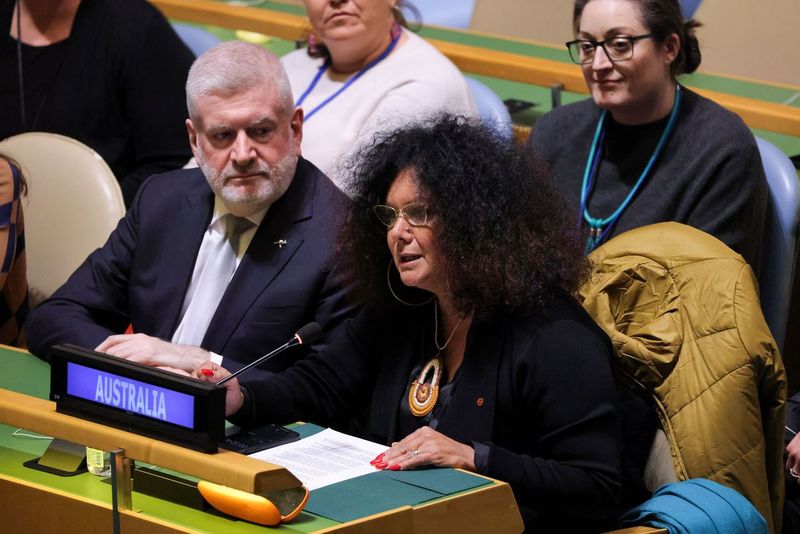
On Friday the Australian government said in a statement it is "delivering for women by investing in 1,000 digital traineeships in the Australian Public Service which are specifically targeted to those who are usually excluded from this sector, including women and First Nations people, and investing $31.6 million over five years to address technology-facilitated abuse and to improve online safety.
Senator McCarthy also told the UN that the government will introduce a National Strategy to Achieve Gender Equality.
Australian Labor activist Jessie Street was instrumental in establishing the Commission for the Status of Women in 1946 as a standalone commission of the United Nations. It remains the premier global institution for advancing the rights of women around the world.
After addressing the Commission, Senator McCarthy said the Labor government has "put women back at the centre of our agenda and has ensured gender equality is a core economic imperative".
"As a Yanyuwa Garrawa woman from Gulf Country in the Northern Territory, I'm incredibly proud and humbled to represent all Australian women and girls with this distinguished delegation on the world stage.
"Australia is serious about achieving gender equality, and we are committed to working with partners across our region and the globe to achieve long-lasting change for women and girls."