





Students from Maam Giingana Gumbaynggirr School have returned from Aotearoa after a cultural and educational trip centred on Māori immersion schooling and Treaty of Waitangi commemorations.
The group travelled with Bularri Muurlay Nyanggan Aboriginal Corporation to Aotearoa for Waitangi Day celebrations, marking the start of the school year with learning experiences grounded in Indigenous language, culture and history.
The trip focused on strengthening connections between Gumbaynggirr and Māori communities while supporting the school's transition to full Gumbaynggirr language immersion.
Gumbaynggirr man and BMNAC chief executive, Clark Webb, described the trip as a significant experience for students and staff.
"It was an amazing trip," Mr Webb said.
"For all of us, but especially for the children, it was really special to be able to learn in that space."
The group's first stop was Hamilton, where students visited Te Wharekura o Kirikiriroa, a Māori immersion school.
The visit provided students with a practical example of what full immersion education looks like in another Indigenous context.
"So first up was Hamilton and we visited a Māori immersion school called Te Wharekura o Kirikiriroa and they basically welcomed us in and gave us an amazing tour of the school and showed us what they do," Mr Webb said.
"Everything is in their language, Te Reo Māori.
"There was a number of children from our school on the trip, so it was great for them to see what a full immersion school looks like."
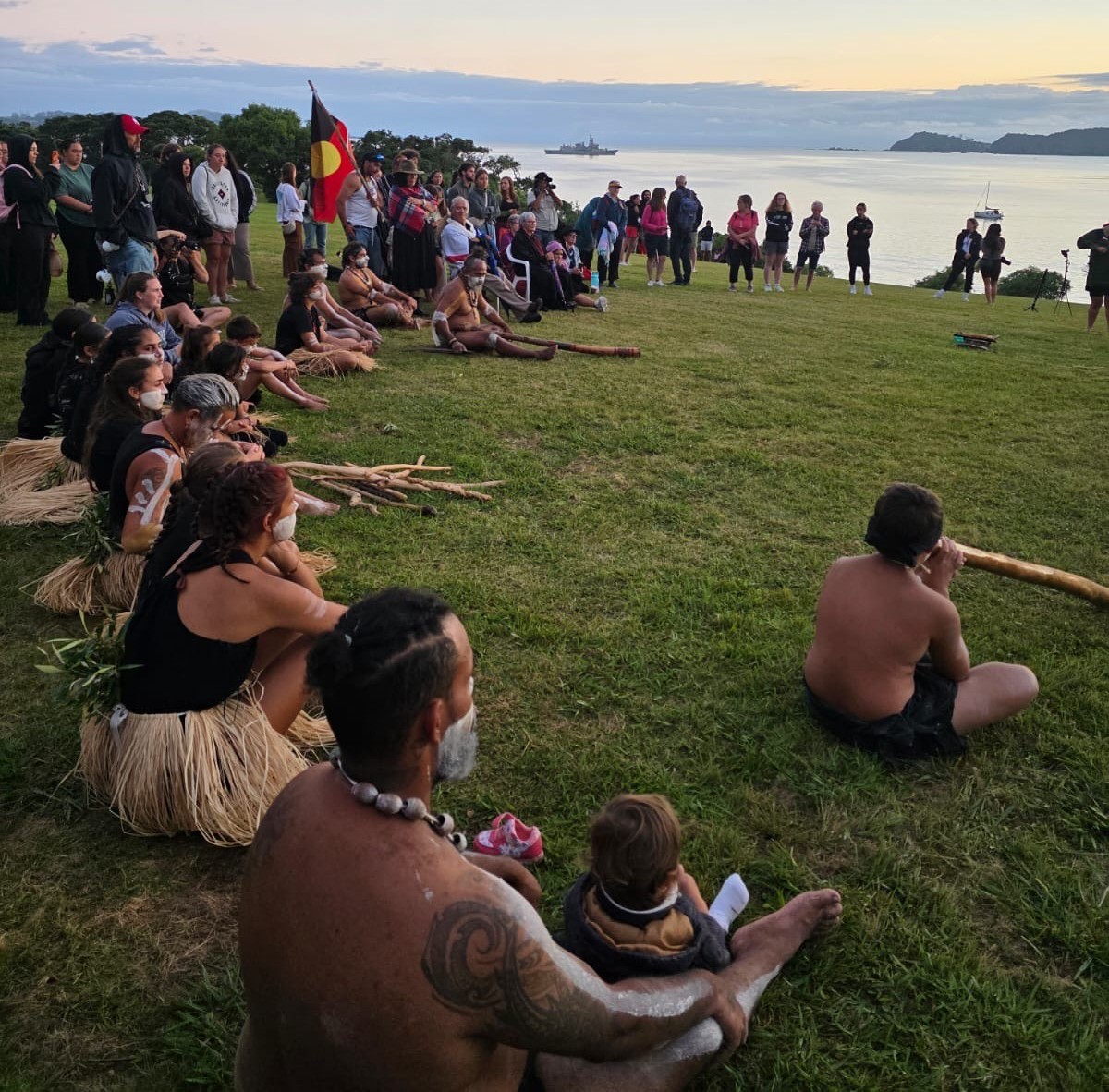
Students were formally welcomed through a pōwhiri (Māori welcoming ceremony), which Mr Webb said left a strong impression.
"They started with a pōwhiri and that in itself was a really amazing experience for our children to be a part of," he said.
Following the Hamilton visit, the group travelled north to the Waitangi Treaty Grounds to take part in commemorations linked to the signing of the Treaty of Waitangi in 1840.
The visit provided an opportunity to explore both the intent of the treaty and its ongoing impact.
"We spoke about the signing of the treaty in 1840, and how there's been a whole heap of disrespect of Māori people and country and language, which is against the principles of the treaty."
He said students were able to see how treaty provisions have supported Māori-led education, while also learning about ongoing challenges.
"The fight then for Māori to have their right to educate their children in the way they see fit through their language and culture, I think our children saw that that is a big benefit of the treaty," Mr Webb said.
"They got to see a lot of the benefits of the treaty, but also how some of the Pākehā (non-Māori people) are trying to use the treaty for their own means as well."
The trip is expected to inform how students and staff continue to shape language immersion at Maam Giingana Gumbaynggirr School, drawing on lessons observed in Aotearoa and applying them on Gumbaynggirr Country.