




Veterans of Kenya's independence rebellion and justice advocates took to the streets in protest over Britain's crimes in the country as King Charles visits this week.
On Tuesday Charles III expressed "deepest regret" and "greatest sorrow" for "abhorrent and unjustifiable acts of violence" inflicted on Kenyans by the British during the Mau Mau uprising in the 1950s.
However, the King fell short of apologising for the acts.
The Mau Mau movement, a nationalist and anti-colonial rebellion in Kenya, was primarily led by the Kikuyu people but also involved members of other ethnic groups in the country opposed to British colonial rule.
Kenyan President William Ruto said the colonial reaction to struggles for freedom across Africa was "monstrous in its cruelty", and he acknowledged the King's willingness to face "uncomfortable truths".
The Mau May rebellion took up arms against the British in a bid to drive them from the country.
The Kenya Human Rights Commission says some 90,000 Kenyans were executed, tortured or maimed during the British response.
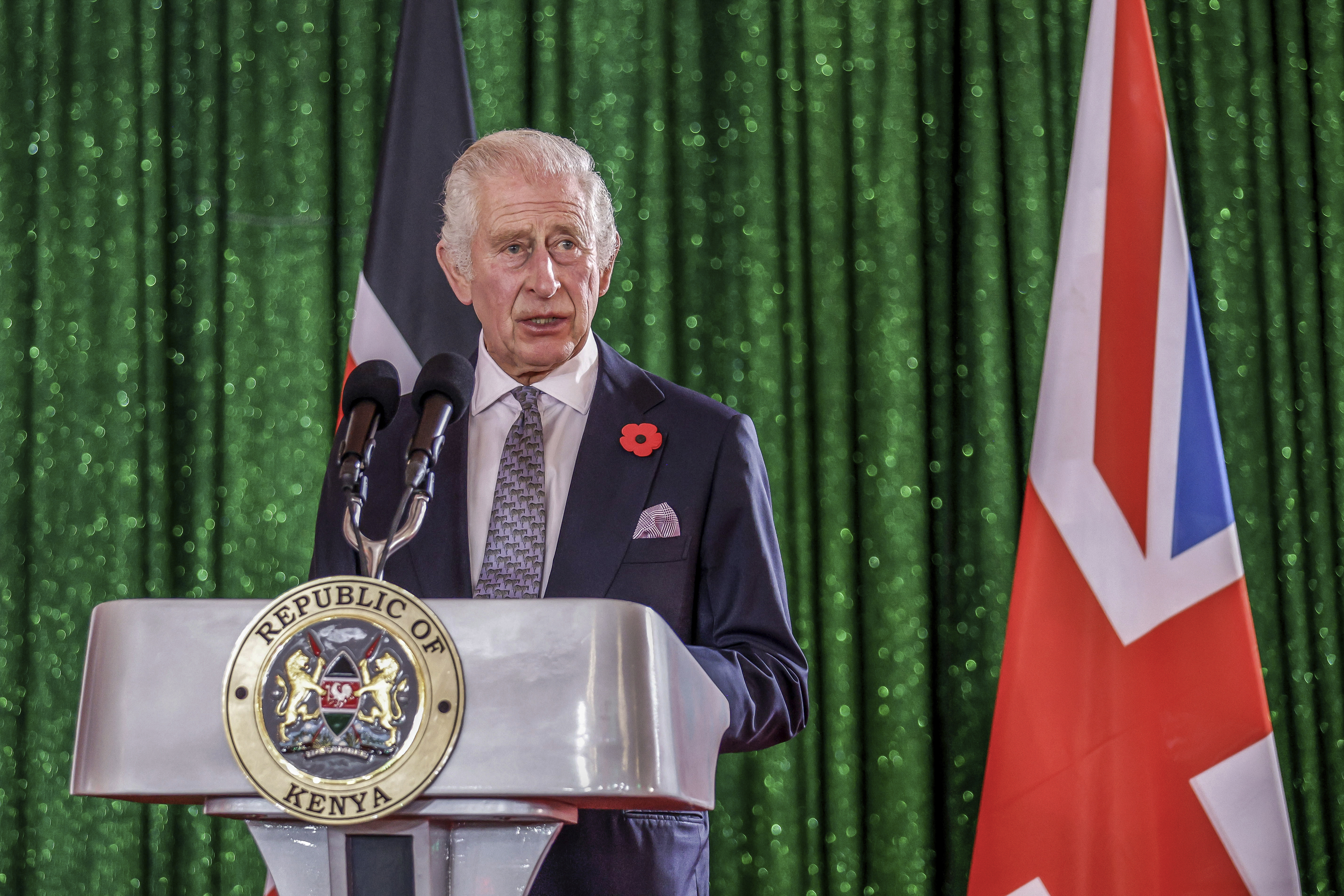
Speaking to 350 banquet guests at the President's official residence in the capital Nairobi, Charles III said "we must also acknowledge the most painful times of our long and complex relationship".
"The wrongdoings of the past are a cause of the greatest sorrow and the deepest regret. There were as they waged, as you said at the United Nations, a painful struggle for independence and sovereignty, and for that there can be no excuse," he said.
"In coming back to Kenya, it matters greatly to me that I should deepen my own understanding of these wrongs, and that I meet some of those whose lives and communities were so grievously affected."
President Ruto noted that colonialism was "brutal and atrocious to African people", and that the "colonial reaction to African struggles for sovereignty and self-rule was monstrous in its cruelty".
"It culminated in the Emergency, which intensified the worst excesses of colonial impunity and the indiscriminate victimisation of Africans," he told the gathered audience.
"While there have been efforts to atone for the death, injury and suffering inflicted on Kenyan Africans by the colonial government, much remains to be done in order to achieve full reparations."
On Monday veterans of the rebellion, in traditional attire, with justice activists, protested in the Mathare area of Nairobi, singing songs of freedom and carrying placards highlighting the crimes of the British Empire and the need for justice.
Early on Tuesday the King and Queen Camilla visited the Tomb of the Unknown Warrior in Nairobi's Uhuru Gardens National Monument and Museum, where Charles laid a wreath with a handwritten note: "In grateful remembrance – Charles R".
Kenyan soldiers served with distinction in Allied forces in the first and second World Wars.
In 2013, the British government made a statement of regret over the "torture and other forms of ill treatment" perpetrated by the colonial administration during Kenya's "Emergency" period of 1952-1960, and paid £19.9 million to about 5,200 Kenyans for human rights abuses (about AUD32.24 million on exchange rates at the time).
This move came after a lengthy legal battle by some surviving victims and the British government.